
Bridging the GenAI Divide · Report
The AI gap starts at the top
Why most AI spend shows no return, and what changed when a leadership team used AI themselves.
95%
of organisations saw no return in their accounts from company-wide AI
MIT NANDA, 2025
56% vs 28%
of senior leaders vs managers who think their company is adopting AI “much faster”
Wharton and GBK Collective, 2025
3 months
from one leadership workshop to an AI Task Force
The Home Depot, 2025
The problem
Tools bought. Usage up. No return in the accounts.
Companies are spending heavily on AI, and most people in them use it for something. Yet 95% of organisations see no return in their accounts from company-wide AI, and only 5% of custom-built AI trials make it into everyday use (MIT NANDA, 2025).
The people furthest from the work are the most confident about it. Senior leaders are twice as likely as managers to say their company is adopting AI “much faster” than competitors, 56% against 28%, and more optimistic about return, 81% against 69% (Wharton and GBK, 2025).
The hype on LinkedIn says everything has changed, but in our operations, nothing fundamental has shifted. We’re processing some contracts faster, but that’s all that has changed.
Think their company is adopting AI “much faster” than competitors
Optimistic about return
Why it starts at the top
Leaders sign the budget, then hand AI to someone else
Leaders who have not used AI on their own work cannot picture what it can do for the business. So the company treats AI as a technical project, and the usage never turns into changed work.
Usage is not capability
Adoption counts how often people use AI. Capability is whether they get good work out of it. A company can have high usage and little capability.
AI becomes someone else’s job
The more senior the leader, the less likely they are to use AI regularly. They hand it to IT, a Head of AI or a consultancy, and the business reads the signal.
Training alone has not fixed it
Confidence in training as the main route to AI skill fell 14 points in a year. 46% of leaders say effective training is one of their biggest talent challenges.
−14 pts
The fix is leaders who use the tools themselves, on their own work, first.

The proof · The Home Depot
When Home Depot’s leaders went first, decisions followed
In 2025, Chair, President and CEO Ted Decker and 40 executives took part in one hands-on workshop. No slides. They used AI themselves on the company’s Pro strategy.
One workshop
40 executives, Ted Decker included. Hands on, no slides.
A real problem
They used AI themselves on the company's Pro strategy.
Three decisions
Who leads AI, who changes how people work, and what to invest in.
AI Task Force
In place within three months.
First payback review
October 2025: what the changes were paying back.
Three decisions came out of the room
A central AI group
With dedicated leadership.
HR leads the change
The EVP of Human Resources put in charge of changing how employees work.
Data
Investment in data infrastructure and data leadership.
Mindstone showed the power of AI tools in a concise manner that brought in a sense of urgency and gave us a lot of momentum to do what we know we needed to do.
Ted DeckerChair, President and CEO, The Home DepotTechnology will be part of our transformation, but it’s as much change management and workflow.
What good looks like
What people who learn to use AI well build
We looked at 1,524 pieces of real work trained people did with AI, from 48 Enterprise AI Academy groups in 2025.
1,524
pieces of real work done with AI
48 Enterprise AI Academy groups, 2025
combined three or more kinds of work in one go
For example writing content, analysing data and planning how to communicate
The benefits mentioned most
12.9%
Better quality
11.7%
Learning something new
7.5%
Speed
Where to start
Four things to do first
Start with the leadership team, on real work, before anything is rolled out to everyone else.
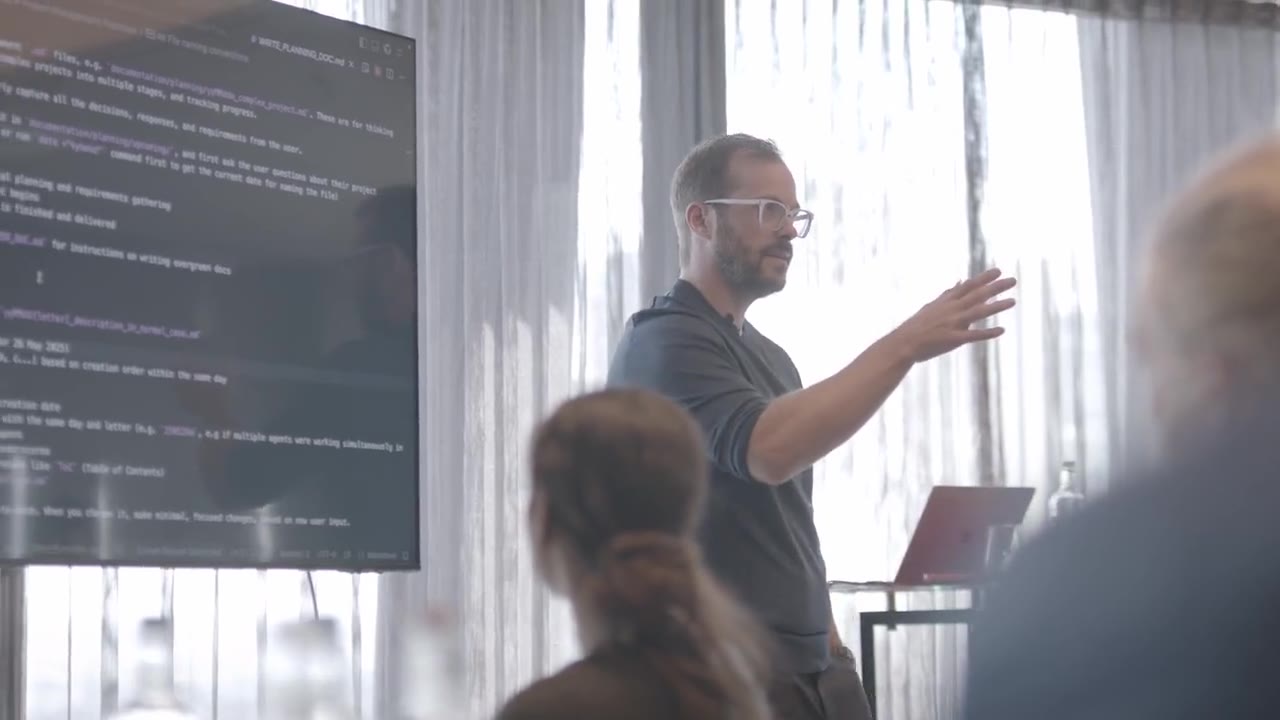
Use AI yourself before you write the strategy
Two hours on a real problem, together.
Lead by doing, not by telling
When leaders use AI on their own work, it stops being someone else's job.
Build work that crosses teams
The strongest work combines several kinds of work in one go.
Measure changed work, not minutes saved
Look for a return in how work gets done, and in the accounts.
Your next step
Where does your leadership team stand?
Find out where your leaders are on AI, and what to do first, before you write the strategy.
Sources
- MIT NANDA, The GenAI Divide: State of AI in Business 2025 (July 2025).
- Wharton Human-AI Research and GBK Collective, Gen AI Fast-Tracks into the Enterprise: Year Three (October 2025).
- Mindstone analysis of 1,524 enterprise AI use cases from 48 cohorts (November 2025).
- Mindstone, The Home Depot case study (2025).